
Technical guide
The advantages of closed die forging for pressure-containing components
A guide for valve, energy and heavy-equipment buyers — what the process actually delivers, where it beats casting and bar machining, and how to tell a capable forging partner from a cheap quotation.
Every component you buy is a decision about risk. A valve body that weeps under pressure, a flange that fails hydrostatic test, a stem that cracks in service — the price of the part is never the price of the failure. That is why the most demanding equipment in oil and gas, power and process plant is not built from castings or parts hogged out of bar. It is built from forgings.
What is closed die forging?
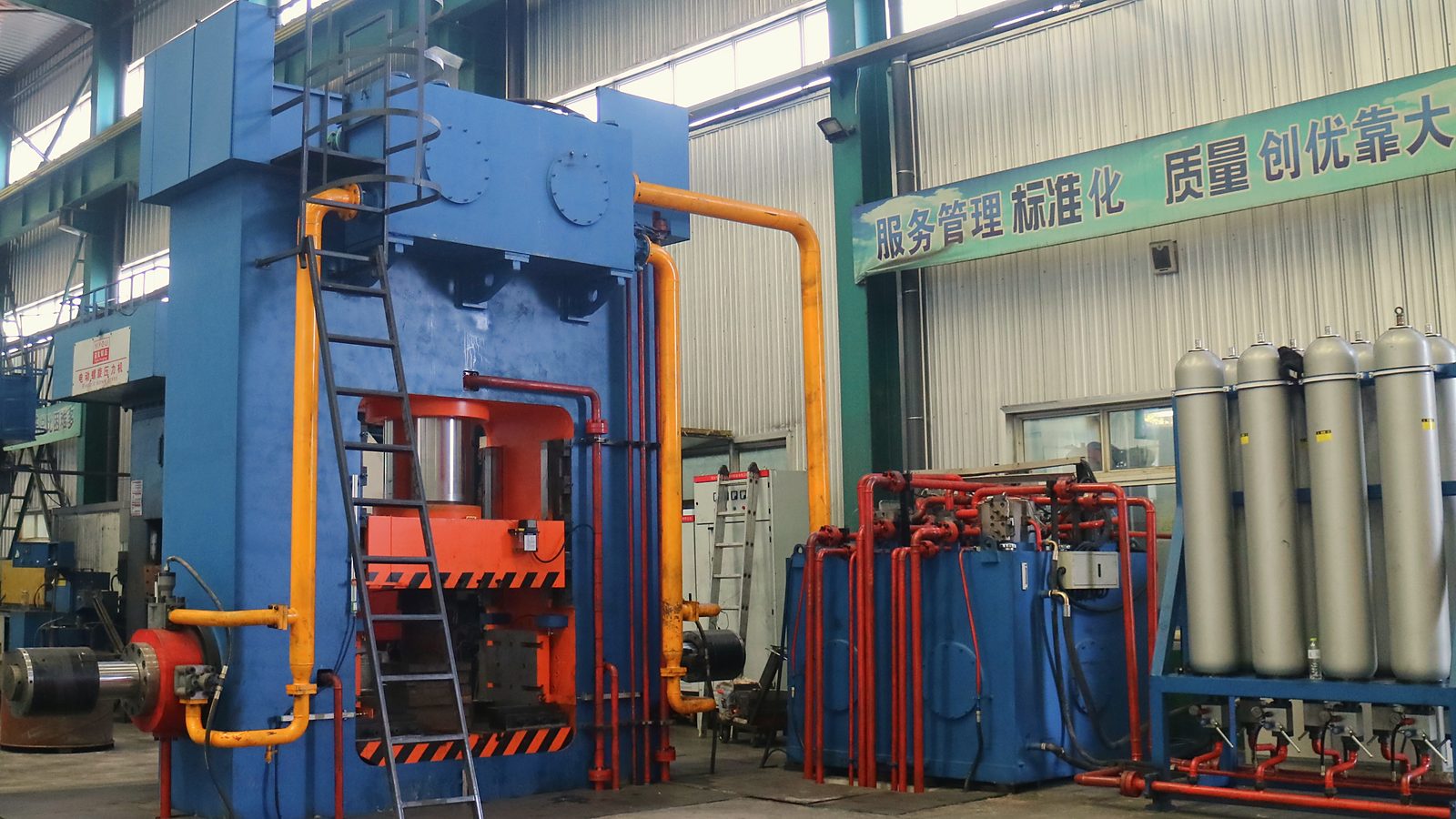
Closed die forging — also called impression die forging — presses a heated metal billet between two precision-machined dies until the metal fills every contour of a sealed cavity, usually in two or three press strokes. The result is a near-net-shape part whose internal grain structure follows the geometry of the component rather than being cut across it.
Why grain flow is the argument that matters
In a casting, the grain structure is set by how the molten metal freezes, and porosity and shrinkage cavities come with it. In a part machined from bar, the cutter slices straight through a grain structure that runs in one direction only. In a forging, the metal is worked so that the grain flows around the load paths and around the contour of the part.
This is why forged components survive fatigue, pressure cycling and impact that other processes do not. For a pressure boundary it is decisive: the part is not merely stronger on a tensile certificate, it fails later, leaks less and passes non-destructive testing first time more often.
“Closed die forging produces parts with optimized grain flow and mechanical integrity that simply cannot be replicated by casting or machining from bar stock. The die design and press sequencing are where experienced suppliers earn their value.”
— Dr. Thomas Altan, Professor Emeritus, Engineering Research Center for Net Shape Manufacturing, The Ohio State UniversityThat last point deserves emphasis. The metallurgy is available to anyone with a press. What separates suppliers is the die design and the press sequence that get the metal into every section of the cavity without folds, laps or underfill — and that is an engineering capability, not a machine you can buy.
The seven advantages of closed die forging
1. Higher strength and fatigue life
Directed grain flow means longer service life under cyclic pressure, high loading and impact. For valve bodies and bonnets this translates into pressure-boundary confidence rather than a number on a test report.
2. No porosity and no shrinkage cavities
Forging consolidates the billet under high compressive force, producing a dense, sound structure. The casting defect mechanisms — gas porosity, shrinkage voids, inclusions trapped during solidification — are simply absent. For parts that must pass hydrostatic test and NDT, this removes an entire category of rejection.
3. Tight, repeatable tolerances
Closed dies hold roughly ±0.5 mm, against the ±3–5 mm typical of open die work. More importantly, part number 5,000 comes out of the die like part number 1, which is what makes stable CNC loading and predictable machining allowance possible in series production.
4. Less metal in the scrap bin
A near-net shape cuts material consumption dramatically against machining a part from solid bar. On a valve body the difference is often between buying one kilogram of steel and buying three.
5. Fewer machining hours in your own shop
Less stock to remove means shorter cycle times, longer tool life and lower cost downstream. The saving lands in the customer's machine shop, which is why total cost and piece price so often point in different directions.
6. Consistency across the whole run
Once the die set and process window are established, the starting geometry is stable batch to batch. Fixture strategy, locating surfaces and machining allowance stop being variables.
7. Lower total cost at volume
The die is a one-time investment and every part afterwards benefits from it. Most parts cross from machined-from-bar economics to forged economics somewhere in the low hundreds of pieces, and the advantage compounds from there.
Closed die forging vs casting vs bar machining
Process selection is mostly a question of volume, tolerance and mechanical duty. The table below is the short version of that conversation.
| Factor | Closed die forging | Open die forging | Casting | Bar machining |
|---|---|---|---|---|
| Tolerance | Approx. ±0.5 mm | Approx. ±3–5 mm | Approx. ±2–3 mm | Tightest achievable |
| Grain flow | Follows part contour | Partially directed | Set by solidification | Cut through |
| Fatigue strength | Highest of the four | Good | Typically well below forged | Baseline |
| Material use | Very efficient | Moderate | Efficient | Poor — high swarf |
| Tooling cost | Moderate to high | Low | Moderate | Minimal |
| Best volume | Repeat production runs | One-offs, very large parts | Low volume, complex shapes | Prototypes, low volume |
The practical rule: below a few hundred pieces, tooling amortisation usually favours machining or casting. Above that, closed die forging tends to win on unit cost and mechanical performance at the same time.
When closed die forging is the wrong choice
An honest guide has to say this. Closed die forging is not the right answer for every part, and a supplier who claims otherwise is selling, not advising.
- Very low volumes. If you need twelve pieces, the die cost will not amortise. Machine them from bar or use open die forging and accept the material loss.
- Highly complex internal geometry. Deep undercuts and internal passages that no die can form may genuinely suit casting better.
- Very large one-off components. Open die forging exists for a reason.
- Parts where as-forged tolerance is the finished tolerance. As-forged surfaces are relatively coarse; if you need a fine finish, machining allowance has to be designed in from the start.
Materials commonly closed die forged for valve service
| Material family | Typical grades | Where it is used |
|---|---|---|
| Carbon steel | ASTM A105 / A105N | General oil, gas and water service; flanges and pressure fittings. |
| Low-temperature carbon steel | ASTM A350 LF2 | Pressure components rated for low-temperature service. |
| Austenitic stainless | ASTM A182 F304 / F304L, F316 / F316L | Corrosive and hygienic service; higher die wear. |
| Low-alloy / Cr-Mo | ASTM A182 F11, F22 | Elevated-temperature and higher-strength pressure duty. |
| Duplex / super duplex | ASTM A182 F51 / F53 / F55 | Chloride-rich and sour service where strength and corrosion resistance both matter. |
What separates a capable forging partner
Plenty of workshops can hit hot steel. Far fewer can design the die, prove the fill on screen, forge it, heat treat it, inspect it and hand over a certification package an auditor will accept. Use these as a scorecard.
- Die design and forming simulation in-house — material flow modelled before any tool steel is cut. It is the single best predictor of a clean first article.
- Their own tool room — a supplier who makes and maintains its own dies corrects a problem in days, not weeks.
- Press capacity that fits your part comfortably, not at the limit of the machine.
- Secondary operations under one roof — heat treatment, machining, blasting and inspection in-house means fewer handoffs and one point of accountability.
- Melt-to-part traceability — every heat traceable from the mill certificate to the finished forging.
- Documentation as routine — EN 10204 3.1 material certificates and first article inspection reports issued as standard, not on request.
- References in your own sector — a supplier proven in decorative hardware tells you nothing about pressure-containing parts.
Frequently asked questions
What is the minimum order quantity for closed die forging?
It depends on part size and material, but production runs commonly start in the low hundreds. Prototype and sample quantities are usually possible at a higher unit price, often using simplified tooling, so the part can be qualified before committing to a series.
How long does new forging tooling take?
Expect roughly two to three months from drawing approval to first production delivery, including die manufacture and first article inspection. Once tooling is proven, repeat orders typically drop to a few weeks.
Do I have to pay for the tooling?
Tooling is normally quoted separately and invoiced once, then maintained for the life of the programme. Tooling cost and piece price should always be shown separately, so you can see where the money goes.
What surface finish can I expect as forged?
As-forged surfaces are relatively coarse and dimensions are held to forging tolerances. Where tight tolerances or fine finishes are needed, the machining allowance is designed into the forging and finished in a subsequent operation — ours or yours.
Is a forged valve body better than a cast one?
For pressure-containing service, generally yes. A forged body has no solidification porosity or shrinkage cavities, higher fatigue strength and directed grain flow. Casting remains the better answer for very complex internal geometry at low volume.
How do I verify a forging supplier I cannot easily visit?
Ask for the current certificates themselves with expiry dates, recent material test reports and a sample first article report. For a significant programme, a third-party audit or inspection agency visit is a small cost against the risk.
Send us a drawing
You do not need to commit to a programme to find out whether we are the right supplier. Send a 3D model and 2D drawing with the material specification and annual volume, and you will get back a tooling estimate, a piece price and a lead time — plus an honest view of where a radius, a draft angle or a parting line change would cut your cost.
Request a quotation Next: one-piece multi-directional forging